
Cambridge Real Estate Agents: Compare Local Agents Before You Sell
Selling a home in Cambridge is not just about choosing the agency with the most signs around town. The better question is which local agent has recently sold properties like yours, understands your part of Waipā, and can explain a realistic selling strategy before you sign anything.
Cambridge sits in the Waipā District, in the Waikato region. Waipā District Council describes the district as centred on urban hubs, including Cambridge, Te Awamutu, Kihikihi, Pirongia, Ōhaupō and Leamington, which means local property knowledge often needs to extend beyond Cambridge township alone.
Before you start calling agencies, find your top local agent in Cambridge with My Top Agent and build a shortlist based on your property, location and selling goals.
TL;DR: How to compare Cambridge real estate agents
● Check that any agent you are considering is licensed through the REA public register before you sign anything. The public register lists licensed agents, salespeople, branch managers and companies.
● Read Settled’s guide to signing an agency agreement so you understand what the agency will do, what you will pay, and how the agreement works.
● Review the Government guidance on selling your house before choosing between selling privately or using a licensed real estate agent.
● Do not choose a Cambridge real estate agent only because they give the highest appraised price. Ask for comparable sales, local buyer insight and a clear campaign plan.
● Compare agents by property type. A Leamington family home, a central Cambridge townhouse, a lifestyle block near Karāpiro and a rural-edge property near Maungatautari may need different selling strategies.
For a more focused start, compare Cambridge real estate agents with My Top Agent before deciding who to invite for an appraisal.
Why comparing local agents matters
Search results can show you which local agents and agencies are visible online, but visibility does not always tell you who is the best fit for your home. Some pages are agency office pages. Some are agent profiles. Some are property listing pages. They can all be useful, but they usually promote a single agency or agent rather than helping you compare your options.
That matters because selling property is a personal and financial decision. A strong agent should do more than promise a good price. They should explain who the likely buyers are, how they would position your property, what recent sales support their appraisal, and how they will manage the campaign if buyer enquiries are slower than expected.
In Cambridge, this comparison is especially important because the market is not one-size-fits-all. A compact home close to town, a large family property in Leamington, a lifestyle property on the edge of town and a premium home near Lake Karāpiro or the rural fringe may attract different buyers. The right real estate agent should understand those differences and be able to show evidence from similar sales.
A good starting point is to compare individual agents, not just agency brands. Two agents in the same office can have very different strengths, sales history, communication styles and buyer networks. You are not only choosing a logo. You are choosing the person who will price, market, negotiate and guide your sale.
What makes a good Cambridge real estate agent?
A good Cambridge real estate agent should be able to prove local experience, not just claim it. Ask which properties they have sold recently in Cambridge, Leamington, Karāpiro, Maungatautari or nearby Waipā areas. The most useful examples are not always the biggest sales. They are the sales most similar to your own property.
For example, if you are selling a family home, ask about recent family-home sales in a similar price range. If you are selling a lifestyle block, ask about similar land size, access, services, water supply, sheds, fencing and buyer objections. If you are selling an investment property, ask how the agent would market it to both owner-occupiers and investors.
A strong agent should also understand the likely buyer pool. Some buyers may already live in Cambridge. Others may be moving from Hamilton, Auckland, Tauranga or other parts of the Waikato. Lifestyle buyers may be looking for space without being too far from town. Families may focus on schools, commute times, bedrooms, garaging and outdoor areas. Downsizers may care more about low-maintenance living and walkability.
The agent’s appraisal should be realistic and evidence-based. Be careful with an appraisal that seems much higher than the others unless the agent can explain it clearly. A high number can feel exciting, but if it is not supported by comparable sales, it can lead to weak enquiry, price reductions and a longer campaign.
If you want help narrowing your shortlist, find a top local Cambridge agent with My Top Agent before you commit to a listing appointment.
Cambridge, Leamington and nearby Waipā areas to consider
Cambridge is part of a wider Waipā property landscape. That means your agent’s local knowledge should include more than the main township. For sellers, this wider setting matters because buyer demand can come from Cambridge, Leamington, nearby lifestyle areas and other Waipā towns.
Central Cambridge
Central Cambridge properties can appeal to buyers who value access to shops, cafés, schools, parks and established streets. Character homes, renovated villas, townhouses and low-maintenance homes may all need slightly different marketing. The right agent should know how buyers compare location, condition, garaging, outdoor space and walkability.
Leamington
Leamington is an important part of the Cambridge market, especially for family homes. When comparing Cambridge real estate agents, ask whether they have sold similar properties in Leamington and how buyer demand differs from central Cambridge. A suburb-specific conversation is more useful than a generic market summary.
Karāpiro and lifestyle-edge properties
Karāpiro and surrounding lifestyle areas can attract buyers looking for space, views, recreation and a semi-rural lifestyle. These properties often need a more detailed campaign because buyers may ask about land use, access, water, outbuildings, maintenance, internet, fencing and commute times. An agent with lifestyle-property experience can make a real difference.
Maungatautari, Fencourt and rural-edge homes
Rural-edge and lifestyle properties near Cambridge may need agents who understand more than residential presentation. Buyers may be comparing land quality, contour, sheds, services, animal suitability and long-term maintenance. The marketing needs to show both the home and the lifestyle clearly.
Te Awamutu and wider Waipā
If you are comparing nearby Waipā locations, it is also worth reading My Top Agent’s guide to real estate agents in Te Awamutu. Te Awamutu, Kihikihi, Pirongia and Ōhaupō are part of the wider Waipā conversation, and some agents may work across more than one town.
Hamilton as the nearest major city market
Hamilton is the nearest major city market, so some Cambridge sellers may also compare buyer movement and agent activity across the wider Waikato. For a city-focused comparison, see My Top Agent’s guide to Hamilton real estate agents.
What should a Cambridge property appraisal include?
A property appraisal should be more than a hopeful sale price. It should help you understand the evidence, the strategy and the risks before you list.
Start with comparable sales. Ask the agent to show recent sales in Cambridge or nearby Waipā areas that genuinely match your property. The most helpful comparisons will consider location, land size, floor area, age, condition, bedroom count, garaging, views, school zones, lifestyle features and renovation level.
Next, ask about the pricing strategy. Would the agent recommend auction, deadline sale, tender, by negotiation or an asking price? Why? How does that method fit current buyer behaviour for your property type? What happens if open-home numbers are low or early feedback suggests the price expectation is too high?
Marketing should also be explained clearly. A good campaign might include professional photography, floor plans, listing copy, property portals, social media, database marketing, open homes, private viewings and buyer follow-up. Not every property needs the same marketing spend, so ask what is essential and what is optional.
You should also ask for a clear breakdown of commission, marketing costs, GST and agreement terms. Govt.nz advises sellers to make sure their agent is licensed, ask for recommendations, check the agent’s experience with similar properties, and get a few agents to view the property before deciding.
After comparing appraisals, get matched with a local Cambridge agent through My Top Agent to check whether your shortlist aligns with local sales performance.
Questions to ask local agents before signing
Use your appraisal meetings to test each agent’s thinking. You are not just asking what your property might sell for. You are checking whether the agent can explain how they would work towards that result.
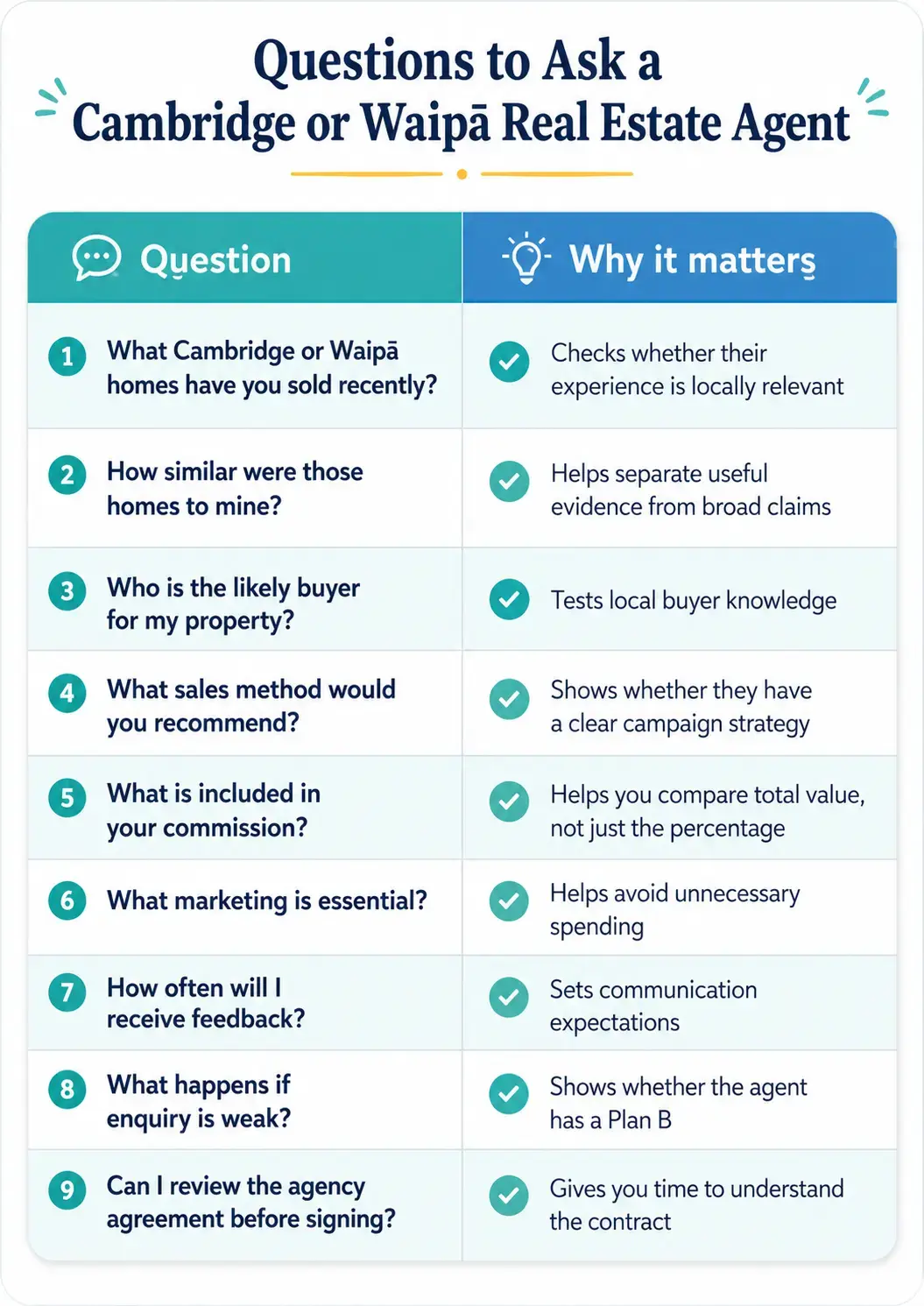
Settled explains that an agency agreement is a legally binding contract between you and the real estate agency, and it sets out the terms and conditions, including what the agent will do and what you will pay. Take your time with it, and get legal advice if anything is unclear.
Common mistakes when choosing local agents
One common mistake is choosing the highest appraised price without checking the evidence. A confident number can be appealing, but your decision should be based on comparable sales, buyer demand and a clear plan.
Another mistake is focusing only on commission. A lower commission does not automatically mean a better result. You need to compare the full service: pricing advice, marketing quality, negotiation skill, communication, buyer follow-up and local experience.
Some sellers also choose the agency brand instead of the individual agent. Brand presence can help, but the person managing your campaign matters most. Ask who will handle buyer calls, open homes, feedback, negotiation and weekly updates.
It is also easy to overlook property-type fit. An agent who is strong with town properties may not be the best person for a rural-edge lifestyle block. An agent who works mainly with entry-level homes may not be the right fit for a premium property.
Finally, do not skip the licence check. The REA public register states that it is illegal to carry out real estate agency work without a licence, and the register lists licensed real estate agents, salespeople, branch managers and companies.
To make the first step easier, find your top local agent in Cambridge with My Top Agent and compare suitable agents before you feel pressured to sign.
How My Top Agent helps Cambridge sellers compare agents
My Top Agent helps New Zealand property owners create a more focused agent shortlist. My Top Agent says it uses your property profile, independent data and sales statistics to identify agents with a proven record of selling similar properties in your suburb. It also states that My Top Agent is not a real estate company and does not have agreements with pre-selected agents.
That positioning is useful for Cambridge sellers because it shifts the decision away from guesswork. Instead of simply searching online, asking one neighbour or choosing the first agent who calls back, you can start with a more relevant comparison.
This does not replace your own due diligence. You should still speak with two or three agents, compare appraisals, check licences, read the agency agreement and decide which person communicates best. But it can save time at the beginning, especially if you are unsure which Cambridge real estate agents are most active with properties like yours.
Cambridge real estate agents comparison checklist
Before you choose a Cambridge real estate agent, compare each agent using the same simple questions.
Check that the agent or agency is licensed on the REA public register. Ask for recent sales in Cambridge, Leamington, Karāpiro or nearby Waipā areas. Make sure they have sold homes similar to yours before.
Ask how they reached their appraisal price, where your property will be marketed, and what the marketing will cost. It is also worth asking how often they will update you during the sale.
Before signing, check the commission, GST, marketing costs and agency agreement terms. Finally, ask what their plan is if buyer interest is lower than expected.
A good comparison process gives you more control. You can see which agents are relying on broad claims and which agents can explain their thinking clearly.
Final thoughts: choose the Cambridge agent who fits your property
The best Cambridge real estate agent is not automatically the most visible name online or the person who gives the highest appraised price. The better choice is usually the agent who can prove recent local results, explain your likely buyer pool, understand your property type and give you a clear plan before you sign.
Take the time to compare agents properly. Check their licence, ask for local sales evidence, read the agency agreement and make sure you understand the full cost of selling. A careful decision at the start can make the whole campaign feel more organised and less stressful.
When you are ready to narrow the field, find your top local agent in Cambridge with My Top Agent and compare suitable local options with more confidence.
FAQ
Q: Who are the best real estate agents in Cambridge?
A: The best real estate agent for your Cambridge property depends on your location, property type, price range and selling goals. Look for recent comparable sales, clear communication, licence status and a realistic appraisal.
Q: How many Cambridge real estate agents should I compare?
A: It is sensible to compare at least two or three agents before signing. This gives you a clearer view of appraised price ranges, commission, marketing costs and campaign strategy.
Q: Should I choose the Cambridge agent with the highest appraised price?
A: Not automatically. A strong appraisal should be supported by recent comparable sales and a clear explanation of buyer demand. If one appraisal is much higher than the others, ask why.
Q: How do I check if a Cambridge real estate agent is licensed?
A: You can search the REA public register by name, business, location or licence number. This helps confirm whether the person or company is licensed to carry out real estate agency work in New Zealand.
Q: Do lifestyle properties near Cambridge need a specialist agent?
A: Often, yes. Lifestyle buyers may ask about land, access, water, fencing, sheds, services and long-term maintenance. An agent with lifestyle-property experience may be better placed to answer those questions and market the property properly.
Q: Is Cambridge part of Waikato or Waipā?
A: Cambridge is in the Waipā District, which is part of the Waikato region. Nearby Waipā areas include Leamington, Te Awamutu, Kihikihi, Pirongia and Ōhaupō.
Q: Can My Top Agent help me compare Cambridge real estate agents?
A: Yes. My Top Agent helps property owners compare suitable local agents using property details, location and relevant sales information, so you can start with a more focused shortlist.
