
Real Estate Agents in Te Awamutu: Compare Local Agents Before You Sell
Choosing between real estate agents in Te Awamutu can feel harder than it should. There are local offices, national brands, rural and lifestyle specialists, agent directories, review platforms and property portals all competing for your attention.
That choice is useful, but it can also make the decision confusing. The best agent for a family home near town may not be the best fit for a lifestyle property outside Kihikihi, a rural block near Pirongia, or an investment property in wider Waipā. A good decision comes down to more than who has the biggest signboards or who gives the highest appraisal.
This guide explains how to properly compare local agents, including what to ask before signing.
TL;DR
● Compare real estate agents in Te Awamutu by recent local results, property type experience, appraisal evidence, communication, fees and licence status.
● Do not choose an agent only because they suggest the highest sale price or the lowest commission.
● Te Awamutu has a competitive agent market, so it is worth comparing individual agents rather than choosing the first familiar name.
● Before signing anything, read the official Settled guidance on selling with a real estate agent in New Zealand, including commission, marketing costs and agency agreements.
● You can also use the REA’s public register of licensed real estate professionals to check whether an agent, salesperson, branch manager or company is licensed.
● If you are unsure what an agent must explain before you sign, Settled’s guide to signing an agency agreement is a useful place to start.
● My Top Agent helps New Zealand property owners compare suitable local agents using property-specific research, independent data and current sales profiles.
Before you start contacting agents one by one, you can compare Te Awamutu real estate agents with My Top Agent and get a clearer shortlist based on your property and location.
Why comparing Te Awamutu real estate agents matters
When people search for real estate agents in Te Awamutu, they are usually close to making a decision to sell. They may be thinking about moving, downsizing, selling an investment, managing an estate sale, or testing what their home could be worth in the current market.
The problem is that a search result page mostly shows who is visible online. It does not automatically show which agent is the best fit for your property.
That difference matters.
A strong agent for a standard three-bedroom home in town may not have the same buyer database or marketing approach needed for a lifestyle property. An agent who sells mainly residential homes may not be the right person for rural land. An agent who gives a confident appraisal may still need to prove that estimate with comparable local sales.
In Te Awamutu and the wider Waipā area, local knowledge can be especially important because property types vary. Sellers may be dealing with town houses, family homes, sections, lifestyle blocks, rural properties or properties in nearby locations such as Kihikihi, Ohaupo and Pirongia.
What you will find when you search for local agents
The current search landscape is not dominated by one type of result. It includes agent directories, review platforms, agency websites, local office pages and individual agent profiles.
Some results are designed to help sellers compare agents by reviews, activity and local experience. Others are built for people who want to browse real estate professionals by location, view recent sales, or contact a local office directly.
Local agencies and offices usually compete in a different way. They often focus on team pages, current listings, property appraisals, sold properties and suburb coverage. Many also highlight nearby areas such as Kihikihi, Pirongia, Otorohanga, Ohaupo and wider Waikato locations.
That mix tells us something useful: sellers are not just looking for a name. They are looking for confidence, local knowledge and a clear reason to choose one agent over another.
Do not compare agencies only. Compare individual agents.
It is easy to start with the agency brand. That is understandable. Te Awamutu has familiar real estate names, and larger brands often have strong visibility.
But when you sell, you are not only choosing a logo. You are choosing the person who will appraise your home, explain the campaign, manage buyers, report feedback, negotiate offers and guide you through the process.
Two agents in the same office may have very different strengths. One may be better with lifestyle blocks. Another may be strong with first-home buyer properties. Another may have a better track record with higher-value homes, rural buyers or deadline-sale campaigns.
That is why comparing individual Te Awamutu real estate agents is more useful than simply picking the agency you recognise first.
What to check before choosing an agent
A good comparison should be practical. Before signing with any real estate agent in Te Awamutu, look at the evidence behind their pitch.
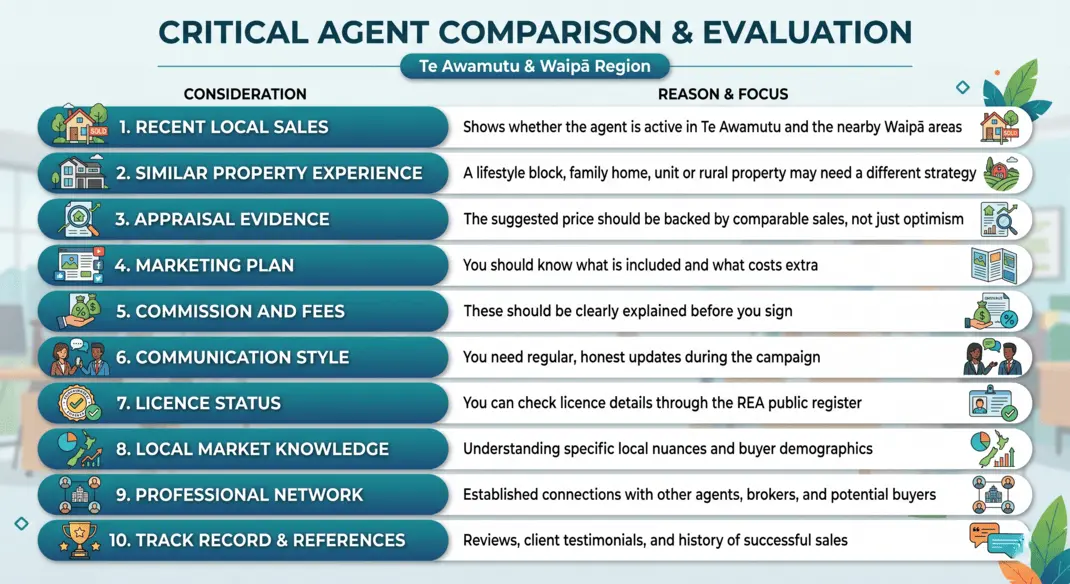
Settled. govt.NZ advises sellers to make a shortlist, invite agents to assess the property, and consider whether they have experience selling similar properties. It also explains key points sellers should understand before working with an agent, including commission and agency agreements.
Why the highest appraisal is not always the best choice
A high appraisal can be tempting. It can feel like one agent understands your home's value better than the others.
Sometimes that may be true. Other times, the number may be more optimistic than realistic.
The important question is not “who gave the highest price?” It is “who can support their estimate with the strongest evidence?”
A useful appraisal should show recent comparable sales, current competing listings, buyer demand, property condition, land size, improvements, location factors and the likely selling method. If an agent cannot explain how they reached the figure, treat the appraisal carefully.
Overpricing can create problems. A property may sit on the market too long, buyers may assume something is wrong, and the campaign may lose early momentum. On the other hand, underpricing or using the wrong sales method can also leave money on the table.
The goal is not simply to choose the biggest number. The goal is to choose the agent with the clearest evidence and the most suitable plan.
Before choosing the agent with the biggest price promise, use My Top Agent to find a suitable real estate agent for your property and compare options with more confidence.
What a Te Awamutu property appraisal should include
If you are preparing to sell, a property appraisal should be more than a quick walk-through and a price range.
A useful appraisal should include:
● Comparable recent sales in Te Awamutu or nearby Waipā areas
● Properties currently competing with yours
● Land size, floor area, condition and presentation
● Renovations, improvements or maintenance issues
● Likely buyer groups
● Recommended method of sale
● Marketing recommendations
● Estimated commission and campaign costs
● A clear explanation of the price range
Official guidance from Settled says that before signing an agency agreement, an agent should give you a written estimate of the sale price, explain how they recommend selling your property, and tell you what commission you will pay.
This is where careful comparison protects you. If two agents give different price ranges or recommend different campaign types, ask each of them to show their reasoning.
Property type matters in Te Awamutu
Not every property needs the same agent.
Te Awamutu and the surrounding Waipā area include a range of property types, so it is worth matching the agent to the sale. A family home may need an agent with a strong open-home process, reliable buyer follow-up and good local buyer knowledge. A townhouse or unit may need someone who understands downsizers, investors and first-home buyers.
Lifestyle properties can require a different approach again. These buyers may care about land size, fencing, sheds, water supply, access and the practical details of rural-style living. Rural properties often need an agent with more specialist knowledge and a wider buyer network, while investment properties may need someone who can speak clearly about rental appeal, likely tenant demand and yield-conscious buyers.
Sections or bare land also need careful handling. The right agent should understand services, access, buyer qualification and development potential.
A lifestyle block outside town should not be marketed the same way as a compact unit close to shops. A rural buyer may care about completely different details from a family looking near schools and amenities.
This is one reason seller research should go deeper than “who has the most listings?” You want an agent who understands your property type, your likely buyer and your local market.
Questions to ask before signing with a Te Awamutu agent
Before you commit, ask direct questions. A good agent should be able to answer clearly.
Ask:
● What have you sold recently in Te Awamutu or nearby Waipā?
● Have you sold properties like mine?
● What price range do you recommend and what evidence supports it?
● Who is the likely buyer for this property?
● What method of sale would you recommend and why?
● What marketing is included?
● What marketing costs extra?
● How is your commission calculated?
● How long is the agency agreement?
● What happens if the property does not sell?
● How often will you update me?
● Will you personally manage the sale?
An agency agreement sets out key details such as what the agent will do, commission, expenses and the timeframe of the agreement. Settled.govt.nz also notes that commission can vary between agencies and may be negotiable.
Do not feel rushed through this step. An agency agreement is important, and you should understand it before signing.
Check that your agent is licensed
In New Zealand, you can check real estate professionals through the REA public register. The register lists licensed real estate agents, salespeople, branch managers and companies. REA also states that it is illegal to carry out real estate agency work without a licence.
This is a simple but important step. It gives you confidence that the person you are dealing with is licensed and visible through the official register.
This is especially useful if you are comparing multiple local agents and want to narrow your shortlist carefully.
How My Top Agent helps Te Awamutu sellers
My Top Agent is not a real estate agency. It does not sell or market your property directly. Instead, it helps New Zealand property owners compare and find suitable local real estate agents.
The service describes itself as independent and free for New Zealand property owners. It says recommended agents are picked based on independent research and current sales profiles, and that it does not have pre-selected agents or an affiliation with a particular real estate agency.
That matters because many sellers do not have time to compare every local profile, review page, recent sale and agency website themselves.
My Top Agent can help simplify the early research stage by reviewing your property details, location, and likely selling needs. Instead of starting with a long list of names, you can work towards a more relevant shortlist.
If you are not sure where to start, enter your property details with My Top Agent and get help identifying Te Awamutu agents who may suit your home, area and selling goals.
Common mistakes to avoid when choosing an agent
Choosing a real estate agent is not only about finding someone friendly or well-known. A pleasant meeting is helpful, but it should not replace proper comparison.
Choosing only on appraisal price
A high price estimate feels good, but it should be supported by evidence. Ask for comparable sales and a clear explanation of how the agent reached the figure.
Choosing only on commission
The cheapest agent is not always the best value. A stronger strategy, better buyer management and sharper negotiation may matter more than a slightly lower fee.
Assuming all local agents are the same
Agents can differ significantly in communication, buyer networks, campaign skill and property type experience. Two agents in the same town, or even the same office, may produce very different selling experiences.
Ignoring marketing costs
Ask what is included, what is optional and what must be paid upfront. Make sure you understand the campaign before approving it.
Not reading the agency agreement
Make sure you understand the timeframe, commission, expenses and cancellation terms. If something is unclear, ask before signing.
Forgetting to check the licence status
Use the REA public register before committing. It is a quick check that can give you extra confidence.
Not comparing similar sales
The most useful evidence is recent sales of properties similar to yours, not broad market talk. A good agent should be able to explain how those sales relate to your property.
So, who is the best real estate agent in Te Awamutu?
There is no single best agent for every seller.
The best real estate agent in Te Awamutu for you is the one whose recent results, property type experience, local knowledge, communication style and marketing approach match your property.
For one seller, that may be a residential specialist with strong family-home results. For another, it may be a rural or lifestyle agent. For another, it may be someone with proven experience selling investment properties or sections.
The right answer depends on your home, your timeframe and your expectations.
That is why comparison matters. A shortlist based on evidence is usually better than choosing the first agent you meet.
FAQ
Q: How do I find the best real estate agents in Te Awamutu?
A: Start by comparing recent local sales, similar property experience, appraisal quality, communication, marketing plans, commission and licence status. The best agent is the one who is best matched to your property, not simply the most visible name online.
Q: Should I choose the agent with the highest appraisal?
A: Not automatically. A high appraisal should be backed by recent comparable sales and a clear selling strategy. Ask the agent to explain the evidence behind the number.
Q: What should I ask before signing with a real estate agent?
A: Ask about recent local sales, similar properties, recommended price range, buyer demand, sale method, marketing costs, commission, agreement length and how often they will communicate with you.
Q: Is My Top Agent a real estate agency?
A: No. My Top Agent says it does not sell or market real estate. It helps New Zealand property owners find suitable local agents through independent research and current sales profiles.
Q: Is My Top Agent free for sellers?
A: Yes. My Top Agent describes its service as free for New Zealand property owners.
Q: Can I check if a real estate agent is licensed?
A: Yes. You can use the REA public register to check the details of licensed real estate agents, salespeople, branch managers, and companies in New Zealand.
Q: Do lifestyle properties near Te Awamutu need a specialist agent?
A: Often, yes. Lifestyle and rural properties may need an agent who understands land, access, water, fencing, sheds, rural buyer expectations and the right marketing channels.
Final thoughts
Selling property is a major financial decision, and choosing the right agent can shape the whole experience. When comparing real estate agents in Te Awamutu, look past the surface-level pitch. Ask for evidence, compare local results, understand the appraisal, check the agreement and make sure the agent is properly licensed.
A strong agent should make you feel informed, not pressured. They should explain the process, support their recommendations and show why they are suited to your property.
Ready to compare real estate agents in Te Awamutu before you sell? Start your free My Top Agent search and build a property-specific shortlist before you list.
