Thames Real Estate Agents: Compare Local Agents Before You Sell
Choosing between Thames real estate agents takes more than selecting the most familiar agency name or accepting the highest appraisal. The right agent should understand your property, its location, the likely buyer pool and the evidence behind its expected selling price.
That can mean different things depending on whether you are selling a central Thames home, a property in Parawai or Tararu, a Thames Coast bach, a lifestyle block near Matatoki or a commercial property around Thames or Kōpū.
This guide explains how to compare local agents, assess their recent sales, understand fees and marketing costs, and ask better questions before signing an agency agreement.
TL;DR: How to compare Thames real estate agents
● Check the individual agent and their agency using the REA public register. You can confirm whether their licence is active and see whether complaints have been upheld against them in the last three years.
● Read the official Settled guide to signing an agency agreement before committing. Check the commission, marketing expenses, agreement duration, cancellation terms and what the agent is authorised to do.
● Before accepting an offer, review the Settled guide to understanding a sale and purchase agreement when selling. A sale and purchase agreement is legally binding, so obtain advice from your lawyer or conveyancer before signing.
● Compare recent sales involving properties similar to yours. Total career sales are less useful when they come from unrelated locations, property types or price brackets.
● Ask every agent to explain their appraisal, recommended sale method, likely buyers, marketing plan, communication process and full estimated costs.
● Interview two or three agents using the same questions. This makes their proposals easier to compare.
● The best agent for a central Thames house may not be the best choice for a coastal home, lifestyle block, rental investment or commercial property.
Find your top local agent in Thames with My Top Agent and begin with a free, no-obligation shortlist matched to your property and location.
Why choosing the right Thames real estate agent matters
A recognised agency can provide useful systems, marketing resources and an existing buyer database. However, the individual salesperson will usually be responsible for appraising your property, managing enquiries, conducting viewings, collecting feedback and negotiating with buyers.
That makes the agent’s personal experience particularly important.
When interviewing Thames real estate agents, look beyond general claims about local knowledge. Ask for evidence that relates directly to your property. An agent who has sold several similar homes nearby may be more relevant than someone with a larger overall sales total from different parts of the region.
The agent should also understand how likely buyer groups differ between locations. A family home in Parawai, a character property near central Thames, a coastal home in Te Puru and a lifestyle property near Hikutaia are unlikely to require identical campaigns.
A useful local agent should be able to explain those differences clearly rather than presenting the same marketing package to every seller.
Before deciding whom to invite for an appraisal, compare Thames real estate agents with My Top Agent based on your location, property type and selling circumstances.
What should a good Thames real estate agent know?
Central Thames and surrounding residential areas
For homes in Thames, Parawai, Totara, Tararu and Kōpū, ask agents about recent comparable sales within the immediate area. They should understand how buyers may assess property condition, section size, parking, access, presentation and proximity to services.
The appraisal should not rely on one unusually high sale or a broad district median. It should use several relevant properties and explain the differences between those homes and yours.
For example, an agent should be able to explain why a renovated home is or is not comparable with an unrenovated property, or how a larger section, additional dwelling or different street position may affect buyer interest.
Thames Coast properties
The Thames Ward extends along the west coast of the Coromandel from Hikutaia to Waikawau and includes settlements such as Te Puru, Waiomu and Tapu.
Selling along the Thames Coast may require an agent who knows how to reach both local buyers and people searching from other parts of New Zealand. The marketing may need to address permanent living, holiday use, accessibility and the practical features of the property.
Depending on the home, buyers may also ask about water arrangements, wastewater, insurance, coastal exposure, maintenance or access. The agent does not need to be a technical expert, but they should know which information buyers are likely to request and encourage the appropriate professional checks.
Lifestyle and rural property
Properties around Matatoki, Puriri, Hikutaia and the wider rural area may appeal to a different buyer pool from suburban Thames homes.
Relevant agent experience may include selling lifestyle blocks, understanding details about the land and outbuildings, arranging longer viewing appointments and presenting features that standard residential photography may not capture.
Ask whether the agent has sold comparable properties and how they plan to reach lifestyle or rural buyers.
How to compare Thames real estate agents
Examine recent comparable sales
Ask each agent to provide three to five recent sales that support their appraisal. Useful comparisons should be similar in:
● Location
● Property type
● Land and floor area
● Age and condition
● Number of bedrooms
● Price bracket
● Sale method
Not every comparison will match perfectly. What matters is whether the agent can explain the differences and how they affected the final price.
Be cautious when the evidence is old, comes from another market or consists mainly of properties that bear little resemblance to yours.
Ask how the appraisal was calculated
A property appraisal should provide a realistic estimated selling range supported by comparable market evidence, not merely a proposed asking price. The agent should explain the evidence, current competition and likely buyer response.
Ask what might cause the property to sell above or below the estimated range. A thoughtful answer should acknowledge that the final result depends on buyer interest, property presentation, campaign execution, market conditions and the terms of any offers received.
The highest appraisal is not automatically the most accurate. Compare the reasoning behind each figure before making a decision.
Review the proposed marketing plan
A good proposal should explain who the likely buyers are and how the campaign will reach them.
Depending on the property, the plan might include professional photography, floor plans, video, property portal advertising, database promotion, social media, signage, open homes and private viewings.
Ask which activities are included in the quoted budget and which are optional. Every recommended item should have a clear purpose.
Compare communication and availability
Strong communication can make a major difference once the property is listed. Establish:
● Who will be your main contact
● Who will conduct open homes
● Who will follow up buyer enquiries
● How often you will receive campaign reports
● How feedback will be presented
● Who will handle negotiations
● What happens when the lead agent is unavailable
Vague answers at the appraisal stage may lead to frustration during the campaign.
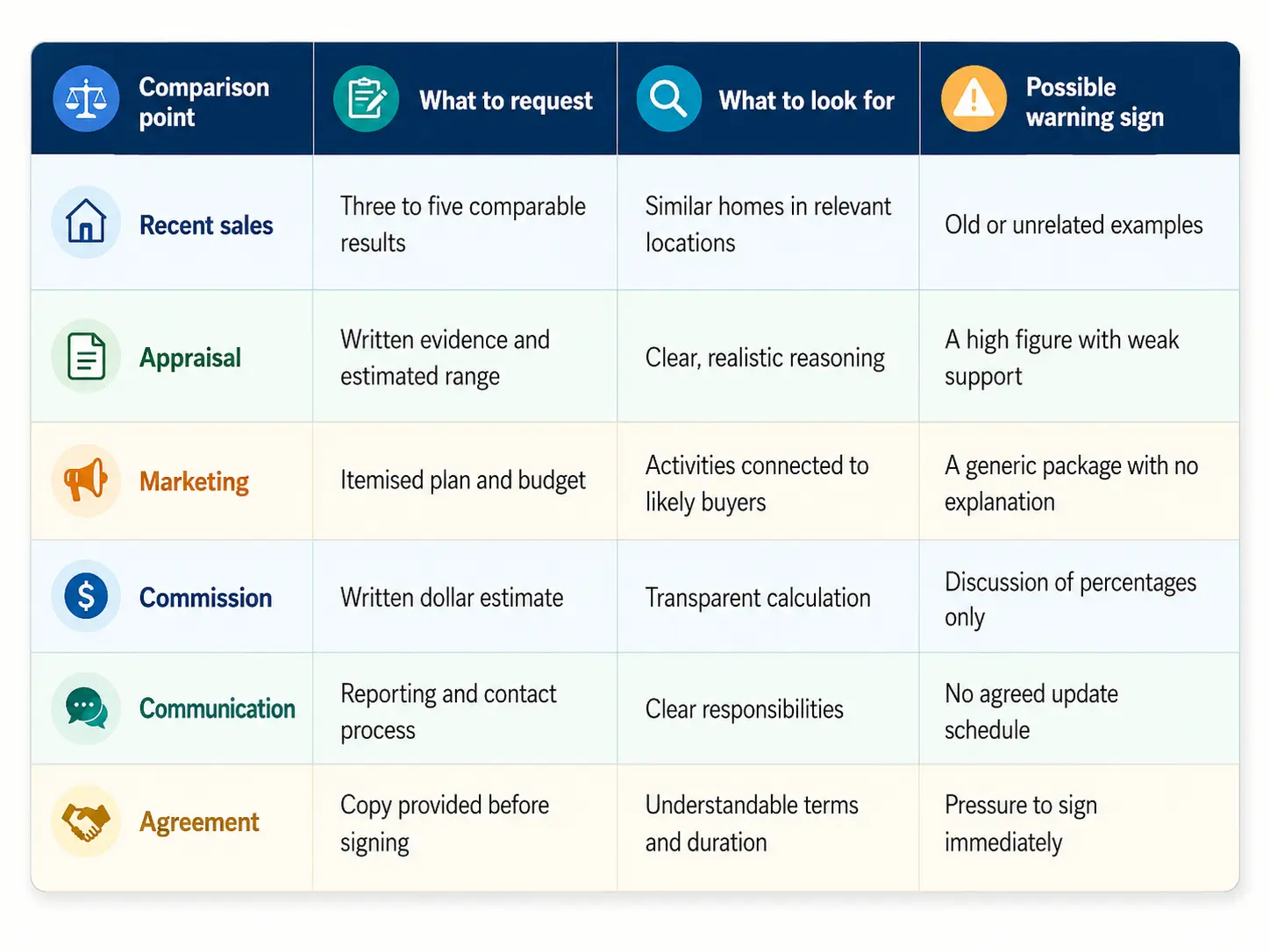
Get your free Thames agent shortlist with My Top Agent before booking appraisal meetings, then use the table above to compare each proposal consistently.
How many agents should you invite for an appraisal?
For many sellers, inviting two or three agents provides enough information without making the process unnecessarily complicated.
Give each agent the same basic information and ask the same questions. Request their appraisal, commission estimate and marketing proposal in writing so you can compare them later.
Ask each agent to explain the evidence behind their range and how the proposed sale method could affect buyer competition. A more conservative range may still be credible when it is supported by recent comparable sales.
The goal is to identify the agent with the most credible evidence and the clearest plan, not simply the most attractive headline number.
Real estate commission and selling costs in Thames
Commission structures vary between agencies. They may include a base fee, one or more percentage tiers, administration charges and GST.
Rather than comparing only the advertised percentage, ask each agent to calculate the expected commission in dollars at several possible sale prices. This gives you a more realistic picture of the cost.
Marketing expenses may be charged separately. These can include:
● Photography and video
● Floor plans
● Premium online advertising
● Social media promotion
● Print advertising
● Signage
● Auction-related expenses
● Property staging or presentation services
Ask which costs must be paid upfront and whether any remain payable if the property does not sell. You should also understand what happens to marketing expenses if you cancel the agency agreement or change agents.
The lowest commission does not necessarily produce the best net result. Consider the cost alongside the agent’s experience, campaign quality, communication and negotiation approach.
Questions to ask Thames real estate agents at a property appraisal
Use the following questions during every agent meeting:
Local experience
Which properties similar to mine have you sold recently?
Which parts of Thames and the Thames Coast do you work in most often?
Where do you expect the likely buyers to come from?
Which recent sales support your appraisal?
What makes my property different from those sales?
Marketing and sale strategy
Which sale method do you recommend, and why?
What is included in the marketing budget?
Which marketing activities are optional?
Who will conduct open homes and private viewings?
How will you follow up interested buyers?
What will you do if the first stage of the campaign produces limited interest?
Fees and communication
What will the commission be in dollars at the appraised price?
Are there administration charges or additional fees?
Which costs remain payable if the home does not sell?
How often will I receive feedback?
Who will negotiate offers?
How long will the agency agreement run?
How can the agreement be cancelled?
An experienced agent should welcome detailed questions and explain their recommendations without creating unnecessary pressure.
Sole agency and general agency agreements
Under a sole agency agreement, one agency has the exclusive right to market and sell the property during the agreed period.
Under a general agency agreement, more than one agency may market the property. You should normally pay commission to only one agency, but the agencies should warn you if there is a risk of paying two commissions.
Before signing multiple agreements, ask each agency to explain its commission entitlement and any post-agreement stand-down period. Read every clause carefully and obtain legal advice if needed.
The REA public register shows licence status and upheld complaints from the last three years, while Settled’s consumer guidance explains what an agency agreement should cover and what the agent must tell you before you sign.
Comparing Thames with Hamilton and Whitianga
Thames sits within a wider regional property market, but experience elsewhere should not automatically be treated as proof of Thames expertise.
Hamilton is a much larger urban market with different suburbs, property types and buyer groups. Sellers also researching the Hamilton market can read My Top Agent’s guide to Hamilton real estate agents.
Whitianga is within the Thames-Coromandel District but serves a different part of the peninsula. Its coastal and holiday-property market should not be treated as identical to Thames or the western Thames Coast. Property owners on the eastern side can explore the guide to Whitianga real estate agents.
Regional experience can still be valuable, particularly when agents have buyer connections across Waikato and the Coromandel. However, the strongest candidate should also demonstrate knowledge of the exact location and type of property you are selling.
Selling in Thames, Te Puru, Waiomu, Tapu or a nearby rural settlement? Find a top local agent for your Thames or Thames Coast property with My Top Agent and start with a more relevant shortlist.
Warning signs when selecting an agent
Be careful when an agent:
● Cannot support their appraisal with comparable sales
● Avoids providing fees and marketing costs in writing
● Pressures you to sign during the first meeting
● Gives generic answers that could apply to any New Zealand town
● Has little recent experience with your property type
● Cannot explain who will manage viewings and buyer follow-up
● Makes firm guarantees about price or selling time
● Dismisses questions about the agency agreement
One warning sign does not always mean an agent is unsuitable. It does mean you should ask further questions before committing.
How My Top Agent helps Thames sellers
My Top Agent is an agent-matching service rather than a real estate agency, and it does not list, market or sell your property. The service is free to property owners; My Top Agent states that an agent may pay it a referral fee if the property sells.
The service helps New Zealand property owners identify and compare potentially suitable agents using property details, location and relevant performance information. Homeowners can review the suggested options, meet agents and decide whom to appoint, without being obliged to use a recommended agent.
This can reduce the amount of time spent searching through office pages, directories and individual profiles before deciding whom to contact.
Choose the agent who fits your Thames property
The right agent should be able to demonstrate relevant local sales, explain the appraisal evidence and show how the proposed campaign fits your property.
Compare complete costs rather than commission percentages alone. Read the agency agreement, check the agent’s licence and make sure you understand who will manage the campaign from appraisal through to negotiation.
The most visible agent, the lowest fee and the highest appraisal are not automatically the strongest choices. A better decision comes from comparing relevant evidence, service and strategy.
When you are ready to narrow the options, find your top local agent in Thames with My Top Agent and start with a free, no-obligation property-specific shortlist.
Frequently asked questions
Q: Who are the best real estate agents in Thames?
A: There is no single agent who is best for every Thames property. Compare agents based on recent relevant sales, property-type experience, appraisal evidence, marketing strategy, communication and fees.
Q: How many Thames real estate agents should I compare?
A: For most sellers, two or three agents are enough to reveal differences in evidence, service and strategy. Compare their written proposals side by side.
Q: How much do real estate agents charge in Thames?
A: Request a written commission estimate in dollars based on the appraised price, with GST, administration charges and separate marketing expenses clearly identified.
Q: Is a property appraisal the same as a registered valuation?
A: No. An agent appraisal estimates a likely selling range using market evidence. A registered valuation is prepared by a registered valuer for a specified purpose. A council rating valuation is different again.
Q: Should I choose the agent with the highest appraisal?
A: Not automatically. Ask the agent to show the comparable sales and explain how their recommended strategy supports the estimated range.
Q: Do I need a Thames Coast property specialist?
A: Relevant coastal experience may be useful where buyers are likely to ask about access, insurance, water, wastewater, maintenance or holiday-home use. Ask for examples of recent comparable coastal sales.
Q: How can I check whether a Thames agent is licensed?
A: Search the REA public register using the individual’s name, business name or licence number. Check that the licence status is active before signing an agency agreement.
