
Real Estate Agents Whangarei: How to Choose the Right Local Expert
If you're comparing real estate agents Whangarei, the smartest move is to shortlist licensed local professionals, compare their recent sales of similar properties, review their pricing logic, and understand the agency agreement before you sign. Too many sellers choose based on the highest appraisal or the biggest brand, but the better decision usually comes from matching your property to the right local specialist.
Many people start with broad searches like 'nz real estate whangarei' or 'real estate whangarei', but those results often mix portals, directories, agency pages, and review platforms. What sellers really need is a practical guide that explains how to choose the right agent, what to ask, what to compare, and how to avoid common mistakes before a listing goes live.
TL;DR: What to check before you choose an agent in Whangarei
● Check that the agent is properly licensed before anything else, using the REA public register.
● Read the official seller guidance at Selling your house to understand what agents should explain.
● Understand the legal side before signing by reviewing Signing an agency agreement.
● Check local council information early through Whangarei property valuations, apply for a LIM, and Online maps.
● Make sure your lawyer or conveyancer reviews the property title and key documents. Background property records can also be checked through Land Record Search.
● Be ready for identity checks because AML/CFT requirements apply to real estate agencies and licensees. You may be asked to complete customer due diligence before signing the agency agreement.
● Do not choose purely on the highest price estimate. Compare local knowledge, buyer strategy, communication, fees, and the total selling plan.
Why real estate agents Whangarei should be compared carefully
The right agent can improve your final result, while the wrong agent can cost you time, money, and buyer confidence. In a market like Whangarei, where different suburbs and property types can behave very differently, choosing well matters more than most sellers expect.
A strong agent helps with pricing, buyer targeting, method of sale, negotiation, campaign structure, and risk management throughout the process. A weaker one may overprice the home to win the listing, under-explain the agreement, or rely on generic marketing that does not match the property.
Start with the licence status, not sales talk
Before you compare promises, verify the person is licensed and active. This is the most basic check and should happen before you place any weight on reviews, appraisals, or brand reputation.
A proper licence check helps you start from facts rather than personality. It also gives you confidence that you are dealing with someone who is allowed to carry out real estate agency work in New Zealand.
Compare the person, not just the brand
A large agency brand may have strong local presence, but your result usually comes down to the individual handling your campaign. That is why the smart question is not just “Which office is well known?” but “Which individual has the right experience for my home?”
The best real estate agent whangarei is usually the one who can show relevant evidence, explain their process clearly, and stay realistic from appraisal to negotiation.
Focus on relevant local proof
The strongest local proof is not a vague statement about market activity. It is a clean list of similar sold properties, recent examples from your area, and a clear explanation of why those sales are relevant to your home.
If an agent cannot explain their comparable sales properly, that is already useful information.
Want to start with an evidence-based shortlist instead of guesswork? See how My Top Agent helps you compare top local agents before you commit to anyone.
How to shortlist real estate agents Whangarei sellers can trust
The direct answer is to shortlist two to four strong options, then compare them on fit, evidence, communication, and clarity. That gives you enough variety to see the differences without turning the process into a mess.
A useful shortlist should include people who know your suburb, understand your type of home, and can explain how they would attract the right buyers. You do not need to meet every agent in town. You need a focused shortlist built around your property.
Shortlist by suburb and buyer type
Whangarei is not one single market. A home likely to appeal to first-home buyers, a premium renovated home, a lifestyle block, and a coastal home can attract different buyers and need different selling angles.
That is why suburb-level experience matters. Ask each agent how buyers are behaving in your specific area, what stock is competing with yours, and what the likely buyer objections will be.
Shortlist by property type and campaign fit
Some agents are excellent with standard residential listings but weaker on unique or specialised properties. Others are stronger when there is a wider buyer search area, a more complex marketing story, or a more niche audience.
The better the match between your property and the agent’s strengths, the more confident the campaign usually feels from day one.
Shortlist by communication quality
A seller often learns more from the appraisal meeting than from the sales pitch itself. Did the agent ask good questions? Did they listen? Did they explain their recommendations in plain language? Did they feel measured and credible, or overly smooth and vague?
Communication matters because the same person will likely guide buyers later, handle feedback, and manage negotiations on your behalf.
What to ask every shortlisted agent
Ask these questions every time so your comparison stays fair:
● What recent homes like mine have you sold?
● What do you think the likely buyer pool looks like?
● What sale method do you recommend, and why?
● How did you arrive at your price estimate?
● What marketing would you recommend for this property?
● What will the total costs likely be?
● How often will you update me?
● What risks do you see with this campaign?
Before you start meeting agents, get a better starting point with My Top Agent so your shortlist is based on fit and performance, not just whoever gets to you first.
What the best real estate agents Whangarei will show you in an appraisal
A strong appraisal should feel grounded, specific, and realistic. It should not just give you a flattering number. It should explain where that number comes from, which sales support it, what buyer response is likely, and how the campaign would be structured.
A good appraisal gives you confidence because it is clear. A weak appraisal creates excitement first and confusion later.
They should explain comparable sales properly
Comparable sales are only useful when they are genuinely comparable. That means looking at location, land size, home size, presentation, condition, property type, and timing.
An agent who simply drops a few random nearby sales into a conversation is not doing enough. The better approach is to explain why each sale matters and how your property sits above, below, or alongside those examples.
They should separate appraisal, value, and expectation
A common problem is when sellers mix together an old valuation, a rating value, a neighbour’s result, and an agent’s estimate. A good agent should separate those clearly and explain what each one means.
That clarity is especially important if your expectations were shaped by a stronger market phase or by a property that was not really comparable.
They should explain the method of sale with logic
Auction, deadline sale, tender, negotiation, or an asking-price campaign should not be chosen by habit. The method should suit the home, buyer demand, timing, and local competition.
A strong agent should be able to say not only what they recommend, but why. They should also explain what happens if the first strategy does not get the expected traction.
They should present a real marketing plan
A real plan should cover photography, copywriting, listing exposure, buyer follow-up, open homes if appropriate, database contact, and a reporting rhythm that keeps you informed.
If the marketing section feels generic, the campaign may become generic too.
They should explain fees in real numbers
You need the cost structure in plain English. That means understanding commission, marketing costs, and any other expenses in dollar terms.
Fee percentage alone is not enough. A cheaper structure can still be poor value if the overall campaign and negotiation are weak.
If you want help comparing the logic behind different appraisals, explore My Top Agent’s matching approach and start with a more structured comparison process.
Before you sign with real estate agents Whangarei, understand the paperwork
Never treat the agreement as a formality. The paperwork matters because, once you sign, the relationship and the agency’s rights are primarily governed by the written agreement, not verbal assurances.
A seller who understands the agreement is in a much stronger position than one who signs on confidence alone.
Understand what the agency agreement actually does
The agreement sets out what the agency is authorised to do, what you may have to pay, how long the arrangement lasts, and the structure of the relationship.
This is one of the most important stages in the process because misunderstandings here can create major issues later.
Know the difference between a good explanation and a rushed one
A strong professional should walk you through the agreement clearly, explain the commission structure and costs, explain the recommended method of sale, and ensure you understand when the agreement ends.
If the explanation feels rushed, incomplete, or overly casual, slow the process down.
Understand sole agency versus broader arrangements
You need to know exactly who has the right to market the property, what happens if another party introduces a buyer, and whether there is any risk of overlapping obligations.
This is not the stage to rely on assumptions. Legal clarity matters.
Get your lawyer involved early
A lawyer or conveyancer should review the agreement and explain any point you are unsure about. Sellers who do this early usually make cleaner decisions and avoid avoidable confusion.
Be ready for identity checks
Identity verification is a normal part of the process. It is better to expect it early rather than be surprised when documents are requested.
Want a no-pressure way to compare options before signing with anyone? Start with My Top Agent and review your options first.
Local property checks that matter before your campaign goes live
The agent matters, but the documents matter too. A seller who understands the property paperwork early is usually in a better position when buyers start asking serious questions.
Whangarei sellers should think about council records, LIM information, title details, maps, hazards, and any known issues before the campaign gains momentum.
Check the council information early
Council tools can help you review property information, rates information, rating valuation information, and mapping details that may become relevant during due diligence.
This does not replace legal advice, but it can help you identify questions early rather than under pressure.
Think about LIM timing
A LIM is not something every seller orders at the exact same point, but it can be useful when you want to surface key council-held information early.
It may also help reduce delays later if buyers or lawyers start asking questions as offers come in.
Understand the title position
Title details can reveal restrictions, easements, and other matters that could affect a buyer's decision. These are better checked before the campaign is live than after a buyer becomes emotionally invested.
Be proactive about known issues
If there are boundary questions, old alterations, water issues, consent gaps, access issues, or anything else unusual, deal with the information early. Campaigns tend to go more smoothly when those matters are identified before negotiation rather than during it.
How to choose the right agent for your type of property
The direct answer is that the right agent depends on what you are selling and how you need the sale managed. Not every strong local salesperson is the best fit for every listing.
That is why “good agent” and “right agent for this property” are not always the same thing.
Standard residential homes
For a typical family home or owner-occupier property, the priorities are usually suburb knowledge, buyer follow-up, presentation advice, open-home handling, and negotiation discipline.
You want someone who understands what local owner-occupier buyers care about and how they compare homes in your area.
Unique, lifestyle, or harder-to-position properties
Unique homes often need stronger story-building, better buyer qualification, and more patience. In these cases, the fit between the property and the agent becomes even more important.
A one-size-fits-all campaign is usually weaker on a distinctive property.
Investment or tenant-affected sales
Investment sales can require more clarity around returns, tenancy position, compliance detail, and buyer expectations. Some agents handle this well, while others are clearly more comfortable with owner-occupier stock.
Overseas vendors and remote sellers
If you are selling from overseas or helping family manage a remote sale, communication quality becomes even more important. You need clear updates, reliable documentation flow, and a process that works well without you being physically present.
Selling remotely or helping from overseas? Use My Top Agent to start with a service built around easier agent comparison.
A practical scorecard for comparing agents side by side
The direct answer is that a written scorecard usually leads to a better decision. It helps you compare evidence rather than relying on charm, pressure, or the highest price estimate. Once a seller scores each appraisal on the same criteria, the stronger option often becomes much clearer.
What to score
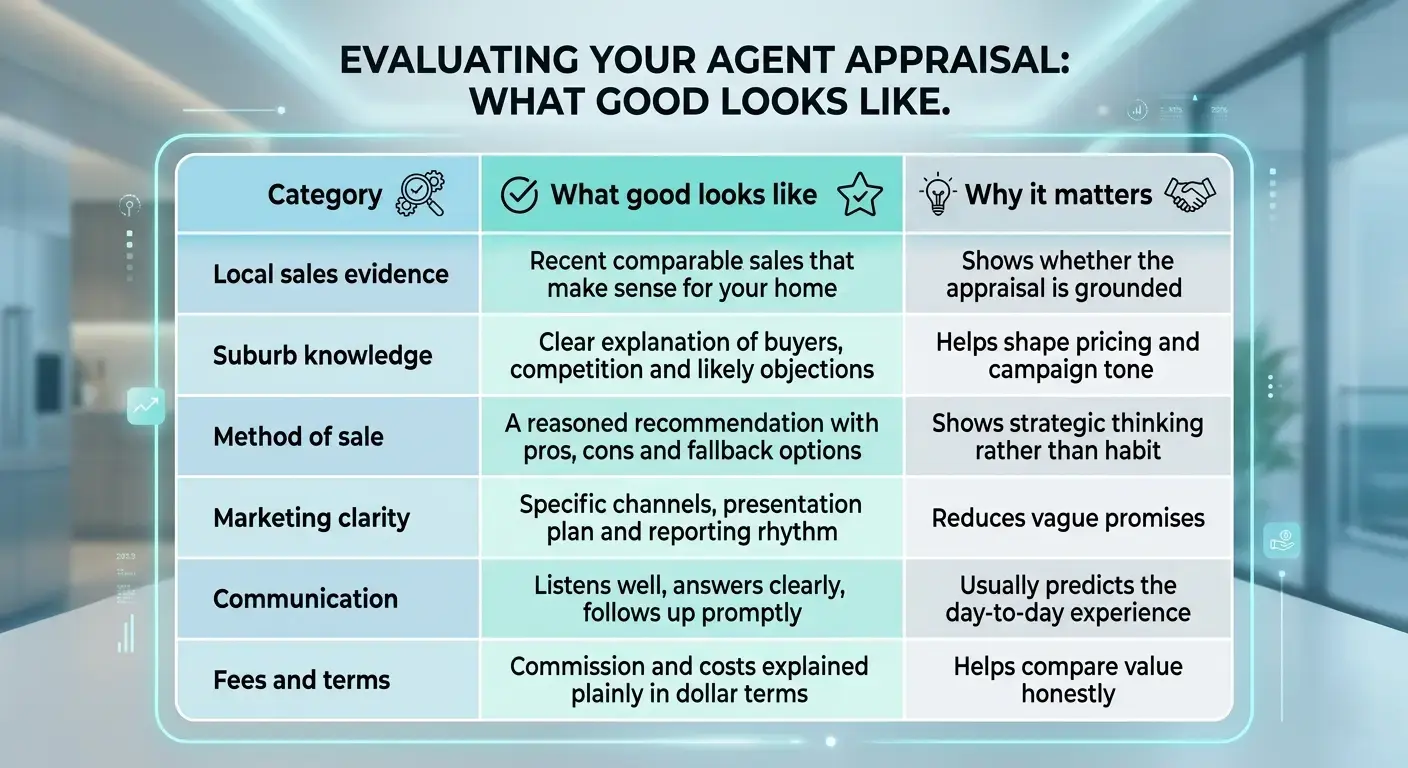
Keep notes after every appraisal
Even very good conversations blur together after a few meetings. Brief written notes will help you remember what each person actually said, which comparable sales they relied on, and how well they answered your questions.
Watch for red flags
· A price estimate that feels exciting but lightly supported
· Vague suburb knowledge or little detail about likely buyers
· Pressure to sign quickly
· Weak explanation of fees or marketing costs
· No clear comparable sales
· Overconfidence without enough evidence
Choose the best fit, not just the loudest pitch
The strongest decision usually comes from evidence, fit, and trust. A calm, well-supported strategy often beats a high-energy promise that cannot be backed up.
Ready to compare agents more objectively? Visit My Top Agent and start with a clearer shortlist.
FAQ
Q: How do I choose between real estate agents Whangarei sellers are considering?
A: Start with licence checks, then compare recent relevant sales, suburb knowledge, appraisal logic, communication, marketing clarity, and total costs. A strong choice usually becomes obvious when you compare the same categories side by side instead of reacting to the highest promise.
Q: How many agents should I speak to before signing?
A: For most sellers, two to four good options is enough. That gives you a real comparison without making the process noisy or repetitive.
Q: Should I always choose the highest appraisal?
A: No. A high appraisal can feel good in the moment, but it is only useful if it is supported by evidence and matched by a realistic campaign strategy.
Q: Is the biggest agency always the best choice?
A: Not necessarily. The agency brand can help with visibility, but the individual handling your campaign is usually what matters most day to day.
Q: What should I ask in the appraisal meeting?
A: Ask about recent similar sales, likely buyer type, method of sale, local competition, marketing strategy, reporting frequency, and total costs.
Q: What makes a strong marketing plan?
A: A strong plan is specific to your home and explains exactly how the agent will attract, qualify, and follow up with buyers rather than relying on vague promotional language.
Q: Do I need a lawyer before signing?
A: Yes, it is wise to have a lawyer or conveyancer review the agreement and explain anything unclear before you commit.
Q: What if I am selling from overseas?
A: Remote sellers should place extra weight on communication, process clarity, and the ability to handle documents and updates smoothly across distance and time zones.
Q: What if two agents seem equally good?
A: Use a written scorecard and compare them on the same factors. The better choice is usually the one with clearer evidence, better listening, and a stronger fit for your exact property.
Q: What is the biggest mistake sellers make when choosing an agent?
A: One of the biggest mistakes is choosing too quickly based on personality, pressure, or the highest price estimate instead of comparing evidence properly.
Final thoughts
For most sellers, comparing real estate agents Whangarei side by side is the safest way to choose the right mix of local knowledge, pricing strategy, communication, and negotiation skill. The smartest path is to verify the basics first, compare the evidence carefully, and sign only when the fit is clear.
If you slow the decision down just enough to check licensing, review comparable sales, understand the fee structure, and have the paperwork properly reviewed, you put yourself in a much stronger position.
The goal is not just to find an agent. It is to find the right one for your property, your suburb, and your selling goals.
